


French
Intent
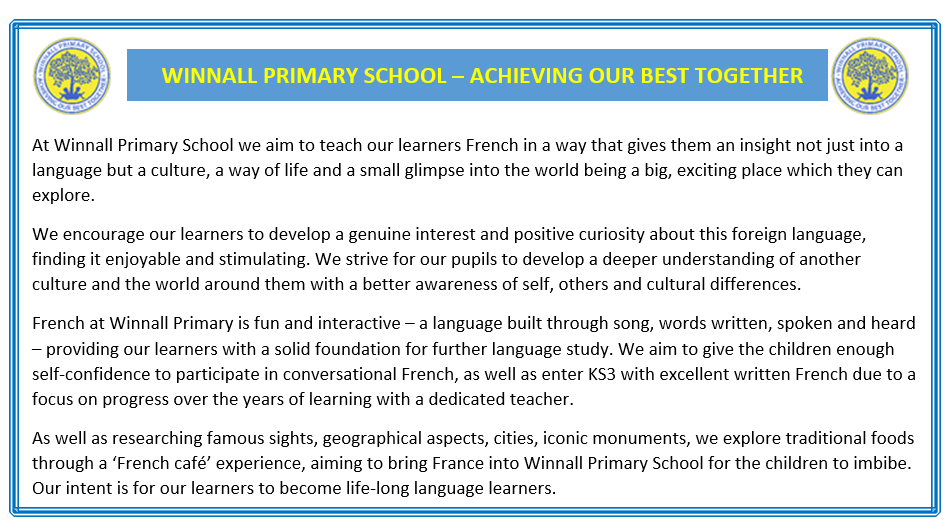
Overview
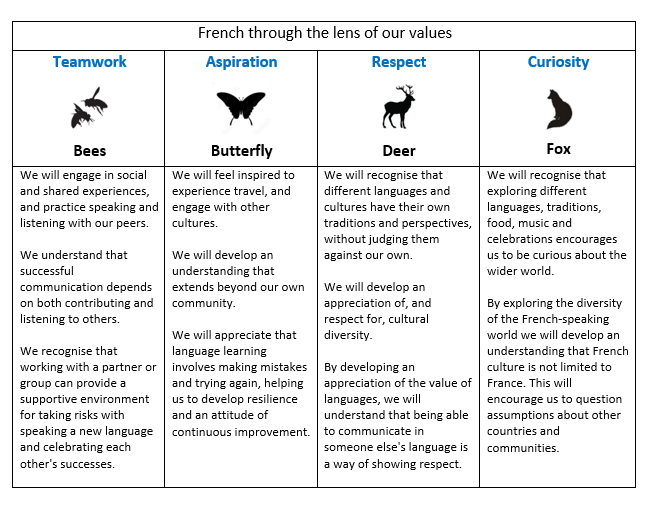
Through the lens of our values
What does a linguist look like at the end of...
What does a Winnall Linguist look like?
What does a Winnall Linguist look like by the end of Year 3?
- Be able to greet others and introduce themselves in French.
- Be able to ask and answer simple questions about themselves, including their name, age and family.
- Have a growing bank of French vocabulary relating to themselves, celebrations, colours, animals and the world around them.
- Be able to understand and use simple French sentences, using familiar vocabulary and sentence structures.
- Begin to recognise and apply key French pronunciation and phonics patterns.
- Begin to read and write simple words and sentences in French.
- Understand that French is structured differently from English and begin to identify simple grammatical differences.
- Show curiosity about French language and culture and recognise some similarities and differences between France and the UK.
What does a Winnall Linguist look like by the end of Year 4?
- Be able to hold short, simple conversations in French using familiar vocabulary.
- Be able to describe the weather, travel, sports, animals and people using simple sentences.
- Be able to ask and answer questions and respond appropriately in familiar situations.
- Have an expanding vocabulary and use familiar vocabulary with increasing confidence and accuracy.
- Be able to read and understand short texts and stories in French and identify key information.
- Be able to write simple sentences, beginning to join ideas using words such as et and mais.
- Apply an increasing knowledge of French phonics to support pronunciation, reading and spelling.
- Understand that French nouns have gender and begin to recognise how this affects words such as adjectives and articles.
- Develop an understanding of French-speaking cultures and make comparisons with their own experiences.
What does a Winnall Linguist look like by the end of Year 5?
- Be able to communicate in French about a wider range of everyday situations, including food, shopping, time, school, travel and directions.
- Be able to express simple opinions, likes and dislikes and give reasons.
- Be able to understand the main points of spoken and written French on familiar topics.
- Be able to write increasingly detailed sentences, using conjunctions and adjectives to add information.
- Use knowledge of French grammar to improve the accuracy of their speaking and writing.
- Understand and apply grammatical concepts including gender, singular/plural forms, adjective agreement and different verb forms.
- Use their knowledge of French phonics to pronounce unfamiliar words with increasing accuracy.
- Recognise cognates and use their knowledge of English to help them understand new French vocabulary.
- Begin to communicate with greater independence, using French creatively rather than relying solely on rehearsed sentences.
- Develop a growing appreciation of the diversity of French-speaking countries and cultures.
What does a Winnall Linguist look like by the end of Year 6?
- Be able to communicate confidently in French in a range of familiar situations.
- Be able to ask and answer questions, express opinions, give reasons and sustain a short conversation.
- Be able to understand the main points and some detail in spoken and written French.
- Be able to write a short, coherent paragraph in French, using familiar vocabulary and grammatical structures.
- Use a range of vocabulary and sentence structures to communicate ideas with increasing independence.
- Apply knowledge of French grammar, including verbs, gender, adjectives, pronouns and sentence structure.
- Recognise and apply French phonics and pronunciation patterns when reading and speaking unfamiliar language.
- Be able to use strategies such as cognates, context and prior knowledge to work out the meaning of unfamiliar words and phrases.
- Understand that French is spoken in many different countries and appreciate aspects of the wider Francophone world.
- Make meaningful comparisons between French and English language and culture.
- Have developed the confidence, curiosity and linguistic skills needed to continue learning a language at secondary school.